As outbreaks in Ontario LTC homes continue why are residents not being taken to hospital for higher care?


FOR IMMEDIATE RELEASE                 MEDIA RELEASE                  APRIL 21, 2020


As outbreaks in Ontario long-term care homes continue

why are residents not being taken to hospital for higher care?


TORONTO, ON – As thousands of hospital staff from many different occupations selflessly volunteer to work in long-term care (LTC) homes afflicted with COVID-19 outbreaks, the Canadian Union of Public Employees (CUPE) is asking whether the decision not to transfer residents to hospital is sound.


In other jurisdictions, which are far more successful at containing COVID-19, long-term care residents are removed to a facility (like a hospital) where they can receive a higher level of care. This ‘isolation’ of residents who have COVID-19, protects those other residents who do not yet have the virus within the home – but are, because of their age or frail condition, at higher risk of infection. Ontario long-term care homes have not been able to apply normal social distancing – in the bedrooms, the shared toilets, the hallways where residents may wander, and the dining rooms. Removing COVID-19 patients from the long-term care homes will make this more possible.


Also, in other countries high testing rates of health care staff, residents and patients is key to containing the spread of COVID-19.


CUPE is asking the Ontario government to rethink some of its recent decisions and move residents with COVID-19 to hospital and to test more of the workforce and patient and resident populations in hospitals and long-term care. Most hospitals in Ontario currently have the capacity to handle these transfers.


“If the evidence is that you remove vulnerable residents with COVID-19 to centres and hospitals specifically set up for that purpose and engage in massive testing, why is the Ontario government going in the other direction? asks Michael Hurley president of CUPE’s Ontario Council of Hospital Unions (OCHU/CUPE). “The courage, compassion, expertise and altruism of the volunteers is very inspiring. But wouldn’t a more effective policy be to move COVID-19 residents out of their long-term care facility to hospital?”


As of midday Monday, 114 LTC homes were in outbreak, with 1,965 residents, staff, and others infected.  Media reports that the Ontario government is under-reporting outbreaks in long-term care by as much as 40 per cent. Infected residents in long-term care are 47 per cent more likely to die than community COVID-19 cases.


Whatever is happening in the community, infection rates in long-term care are not peaking yet. “Sadly, there are many residents dying,” says CUPE Ontario secretary-treasurer Candace Rennick who is critical of the provincial government’s policy that redeploys hospital staff to long-term care.


“This is flawed, because while staff in long-term care are restricted to working at only one facility, hospital staff can return to their hospital, as long as they are asymptomatic”, says Rennick. “Given that these staff are being sent into long-term care facilities which are in outbreak, there is a risk that some staff will be allowed to return to their hospital position without undergoing testing or isolation.
Letter to Premier Ford – April 15, 2020


Dear sisters and brothers,

CUPE, SEIU, Unifor, and OPSEU have written to the Premier asking for the Ontario government to pay for part-time for their sick leave and due to COVID-19, to pay part-time and full-time for isolation and quarantine for COVID-19 and to make whole losses incurred by any health care worker as a result of the one site policy in effect in long term care.

English: Letter to Premier Ford – April 15, 2020


Revised Directive #5 (PPE)

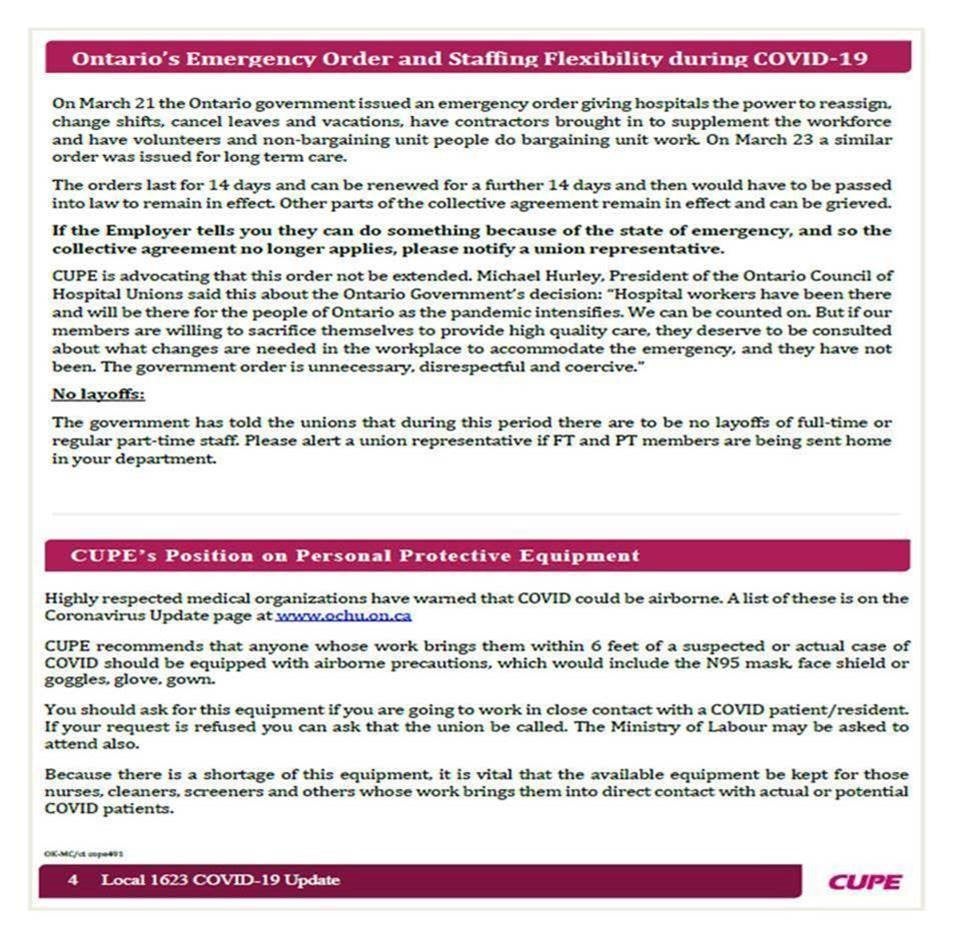
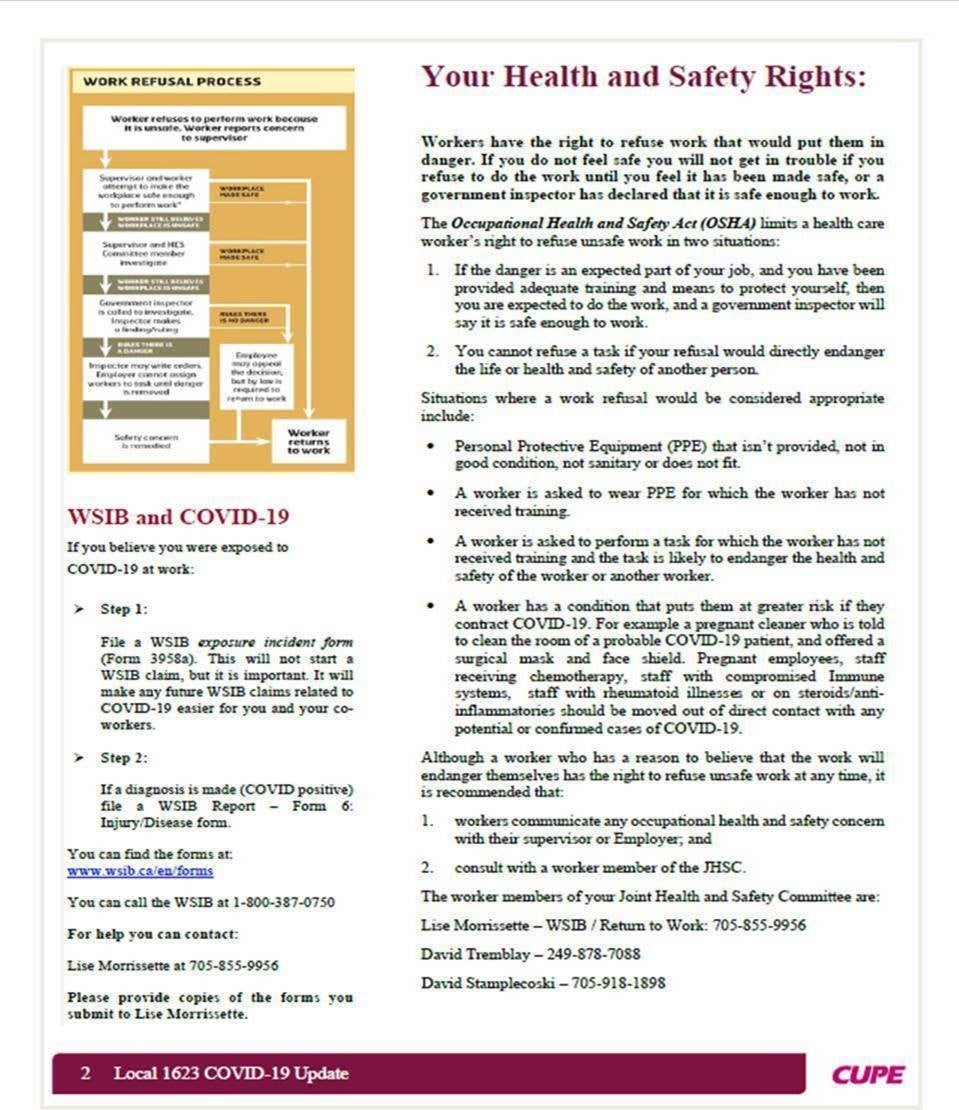
Following membership actions around access to PPE, and through joint efforts with other unions in the health care sector, the previous directive negotiated by ONA has been expanded to include other staff in hospitals, and to include LTC (both nursing homes and retirement homes).

Please review the directive in detail as there are a few pieces to draw your attention to:


  • The first paragraph (above the first bullet) in the Required Precautions and Procedures section defines important terms contained within the scope of the directive:
    • “health care worker” refers to a regulated health professional as defined under the Regulated Health Professionals Act;
    • “other employees” refers to other employees employed by or in public hospitals and long term care homes – for our purposes this would cover PSWs, housekeeping, dietary, etc…
  • Only “health care workers,” as defined above, are able to perform the point-of-care risk assessment (PCRA);
  • If a PCRA has been performed, and it has been determined that N95s are required, we are in a very strong position to insist that those cannot be unreasonably denied;
  • We can point to this directive to also assert that anyone working within 2 metres of a suspected, or confirmed, COVID resident should be provided appropriate PPE, including an N95;
  • If there is a possible shortage of PPE that the Employer must consult with the union on contingency plans (3rd bullet). We are also supposed to engage on the conservation and stewardship of PPE (1st bullet). Those two bullets can be combined to make a very compelling case for employers to engage pro-actively in open discussion around PPE supply, but at minimum there is a clear requirement to consult in the event of a possible shortage.
  • Please keep the working group informed of examples where staff have requested an N95 and have been refused so that we can assess and advise on next steps, including work refusals and complaints to the MOL.

English: CMOH Directive 5 Revised 2020-04-10

Tell your MPP you demand health care workers are protected during COVID-19

Ontario health care workers aren’t receiving the personal protective equipment (PPE), training, and frank communication from the provincial government that they need to safely care for COVID-19 patients.

This is unfair. And it puts them in harms way.

At a moment when we are asking nurses, personal support workers, cleaners and other health care workers to step up and protect people, we must be able to protect them as well.

In the fight against COVID-19, stand with Ontario’s health care workers.

Give them all the high calibre masks, face shields and gowns needed now to ensure they are protected from COVID-19.

All our lives depend on it.

Tell your MPP you demand health care workers are protected during COVID-19.


Sticker Day – April 2

Wear your sticker on April 2 to show you support safe working conditions for health care workers and patients.

Employment Standards Amendment Act (Infectious Disease Emergencies), 2020.

Memo CUPE Local 1623


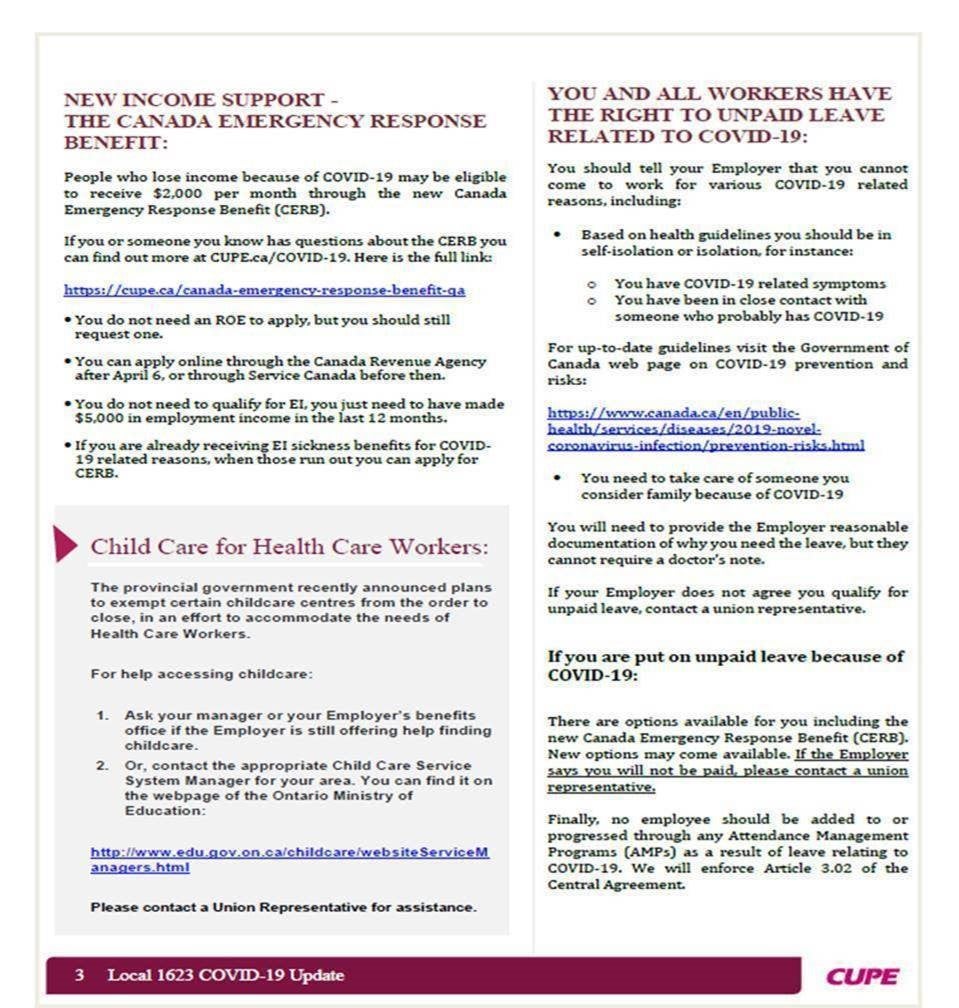
The Ontario legislature passed the Employment Standards Amendment Act (Infectious Disease Emergencies), 2020.

Summary of Legislation

The primary change creates job-protected leaves for individuals if a regulation has been created by the Cabinet setting out a “designated infectious disease” AND one of the following applies to the employee:

1. The employee is under medical investigation, supervision or treatment related to the “designated infectious disease”,

2. The employee is acting in accordance with an order made under section 22 or 35 of the Health Protection and Promotion Act relating to the “designated infectious disease”,

3. The employee is in quarantine or isolation, or is subject to a control measure (such as self-isolation) and the quarantine, isolation or control measure was implemented because of information or directions regarding the “designated infectious disease” issued to the public or to a specific person or group by a public health official, a qualified health practitioner, Telehealth Ontario, the government of Ontario, the government of Canada, a municipal council or a board of health,

4. The employee is under direction given by their employer in response to a concern the employee may expose others in the workplace to the “designated infectious disease”,

5. The employee is providing care or support to a person in a list set out below because of a matter relating to the “designated infectious disease” that concerns the individual from the list, including school and day care closures,

6. The employee is directly affected by travel restrictions related to the “designated infectious disease” and in the circumstances cannot reasonably be expected to travel back to Ontario, or

7. Any other reason that may be established by a regulation.

The people referred to in point (5) above are:

a. The employee’s spouse,

b. A parent, step-parent or foster parent of the employee or the employee’s spouse,

c. A child, step-child or foster child of the employee or the employee’s spouse,

d. A child who is under legal guardianship of the employee or the employee’s spouse,

e. A brother, step-brother, sister or step-sister of the employee,

f. A grandparent, step-grandparent, grandchild or step-grandchild of the employee or the employee’s spouse,

g. A brother-in-law, step-brother-in-law, sister-in-law or step-sister-in-law of the employee,

h. A son-in-law or daughter-in-law of the employee or the employee’s spouse,

i. An uncle or aunt of the employee or the employee’s spouse,

j. A nephew or niece of the employee or the employee’s spouse,

k. The spouse of the employee’s grandchild, uncle, aunt, nephew or niece,

l. A person who considers the employee to be like a family member, provided any conditions that might be set out in a regulation are met, and

m. Any individual that are deemed to be a family member in a regulation

The legislation also provides that employers may require “evidence reasonable in the circumstances” to take the leave, but cannot require a medical certificate.

The leave lasts as long as the employee is not performing job duties for one of the reasons set out above, and so long as there is a “designated infectious disease”.

Regulations that are made under this legislation can be made retroactive.

These changes can be found in section 50.1 of the Employment Standards Act.

It should be noted that these are job-protected, but unpaid, leaves of absence. If relevant paid leave is not available, employees should explore if income supports are available through, for example, the EI system.


If you have any questions or concerns, please contact a member of the working group.

Lise Morrissette – WSIB / Return to Work: 705-855-9956
Marc Mailloux Sr. – 705-566-3332
Marc Mailloux Jr. – 705-662-2797
Karen Brosseau – 705-855-8279
David Tremblay – 249-878-7088
David Stamplecoski – 705-918-1898
Cathan Pasanen – 705-665-1802
Marion Van Horn – 705-919-8054
Mark Valkama – 705-270-1140
Sheryl O’Brien – 705-919-4227
Lindsy Sauve – 705-920-4017

Dave Shelefontiuk –705-929-8457
Janet Fitzgerald – SJCCC: 705-694-9111